Early Access Release
Back to Articles

Why We Built Tagixo
No results found
I've spent most of my career as a backend developer in the Laravel ecosystem. Over the years I've worked with Nova, Filament, Backpack — and eventually built my own admin panel framework, Primix. The backend side of a project has never been the problem.
The problem has always been the frontend.
The Conversation I Had on Every Project
A client comes to you needing two things: an admin panel to manage their data, and a website to present their business. The admin panel — straightforward. Laravel, Filament, done. The website — suddenly the project doubles in complexity.
Not because it's technically hard. But because someone has to build it. Page by page, layout by layout, in HTML and CSS, by hand. And when the client asks to move a section or add a new page six months later, that someone is still you.
I had this conversation on almost every project. And for years, my answer to the frontend problem was the same as a lot of Laravel developers I know: WordPress.
Why I Was Running Two Stacks
I used Divi on WordPress more than I'd like to admit. It solved a real problem — visual composition, fast iteration, clients who could make simple edits without calling me. But it meant maintaining two completely separate systems for every project. A Laravel application doing the real work on one side, a WordPress site doing the presentation layer on the other. They never integrated cleanly. Every deployment was more complicated than it needed to be. And every time the client's needs grew, the gap between the two systems became harder to bridge.
I kept looking for a visual builder that worked inside Laravel. Something that would let me — or my client — compose pages visually, without leaving the stack I'd already built everything else on.
It didn't exist.
So I Built It
Tagixo started as a solution to my own problem. I wanted to stop building frontends by hand, stop reaching for WordPress as a workaround, and stop being the bottleneck every time a client needed a content change.
The goal was clear: a true visual builder, native to Laravel, that covered not just pages but the full range of frontend output a typical project needs — emails, PDFs, forms. One interface, one stack, one integration point.
It took time to get right. A block editor would have been faster to build, but it wouldn't have solved the problem. The difference between picking a predefined block and actually composing a layout visually is the difference between a form and a canvas. We built the canvas.
What Tagixo Is Today
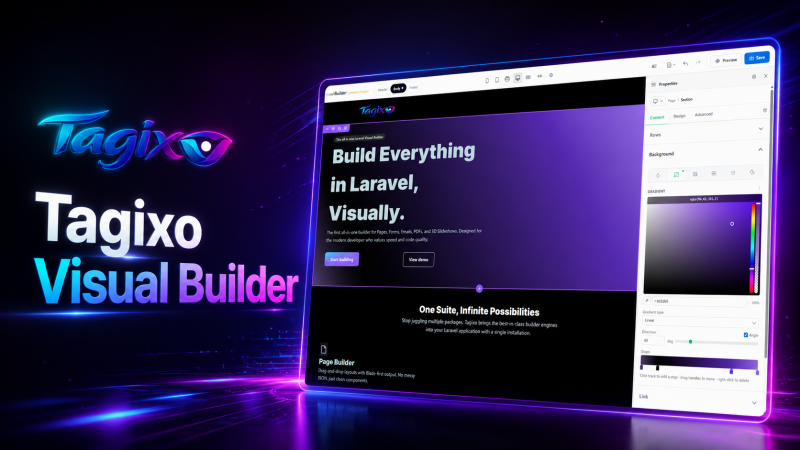
Tagixo is a visual builder for Laravel. It installs as a Composer package, integrates with Filament via an official SDK, and gives developers and their clients a single interface for composing pages, emails, PDFs, and forms — all rendered natively by Laravel.
You define the components and set the boundaries. Everything inside those boundaries can be built and edited visually, without touching code.
It's the tool I needed on every project for the last ten years. I'm glad it finally exists — and I'm glad I get to share it.
Claudio Castorina - 2026-07-04 19:36:00
Related Articles
Why Laravel Developers Should Care About Visual Editing